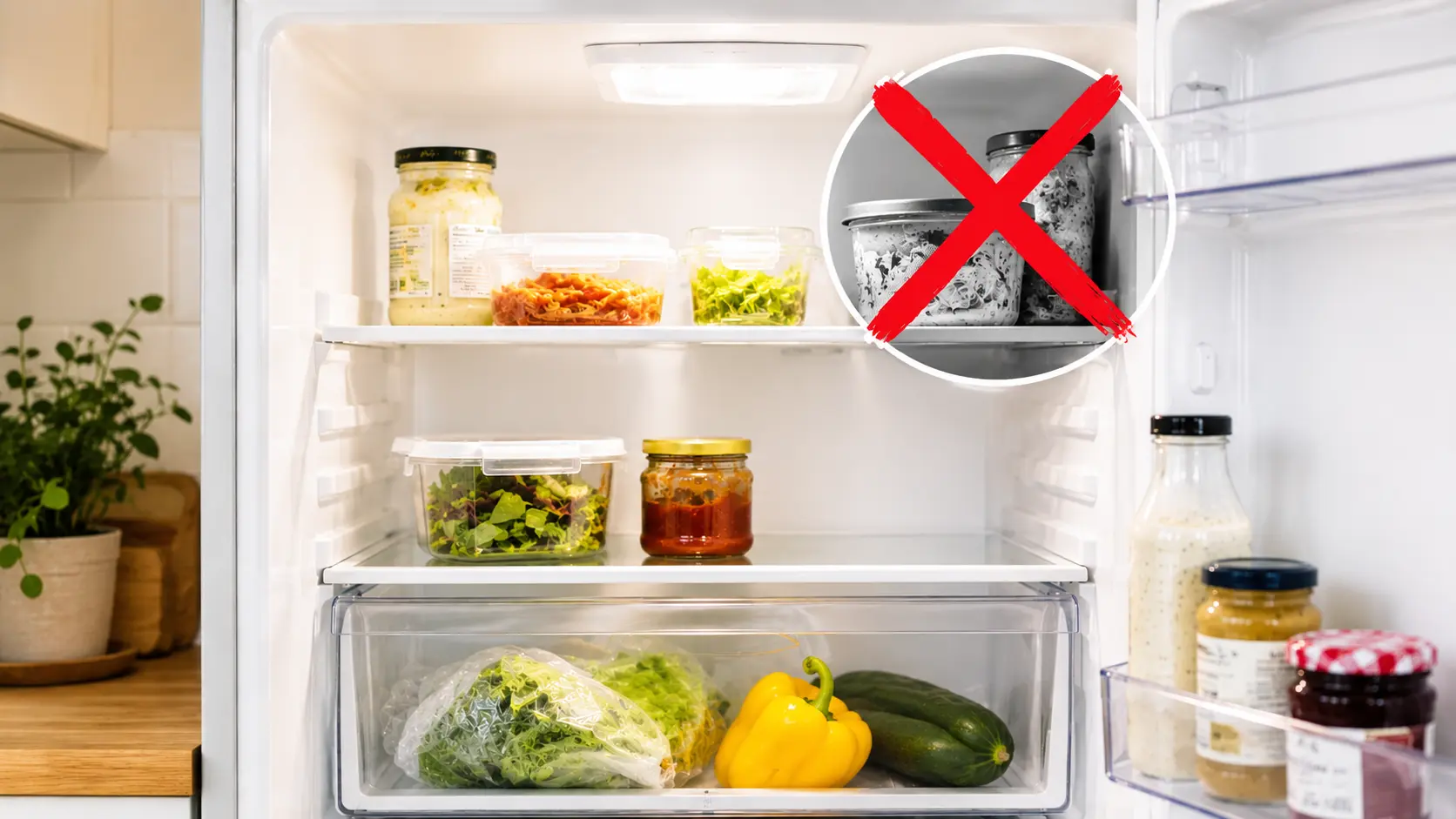
You open the fridge. It’s packed. But somehow, nothing looks good, nothing is easy to grab, and something in the back smells like it’s been there since last month. You close the door, order takeout, and tell yourself you’ll deal with it this weekend.
That leftover chicken, the half-used bag of spinach, those three open jars of pasta sauce — you meant to use all of it. You just couldn’t see it in time.
Here’s the number that should make you put down your phone and pay attention: the average family throws away $1,500 worth of groceries every year, and an average single person throws around $760 a year. And it’s not because they buy too much. It’s because they can’t see what they have, can’t find things before they expire, and don’t have a system that keeps the fridge working for them instead of against them.
The right tools for organizing a fridge don’t just make it look cleaner, they also make food last longer, eliminate the mystery containers, cut the grocery waste you don’t even realize is happening, and make cooking on a Tuesday evening feel like something you’d actually want to do.
Why Your Fridge Is Working Against You (And How to Fix It)
The anatomy of most fridges is working against you by design. Shelves are deep, not wide, so anything placed more than one row back becomes invisible within 24 hours of grocery shopping. You keep buying duplicates of things you already have because you couldn’t see them. You keep discovering food only after it’s too late because it got pushed to the back.
Your Fridge Has Temperature Zones — Most People Ignore Them
Your fridge isn’t one uniform cold box. It has distinct zones, and storing food in the wrong one can shorten its life by days — which is where a significant portion of that $1,500 goes.
- Fridge door: The warmest zone — best for condiments, jams, juices, and sauces. Not for milk or eggs, despite what most fridge door designs suggest.
- Top shelf: Consistent temperature — ready-to-eat foods, leftovers, drinks, packaged items.
- Middle shelf: Stable and moderate — dairy, eggs, snacks, cut fruit, and anything you reach for daily.
- Bottom shelf: The coldest zone — raw meat, fish, and poultry go here, where they stay coldest and can’t drip onto anything else. Only place raw proteins here if you plan to cook them within 1-3 days.
- Crisper drawers: High-humidity drawer for leafy greens and vegetables; low-humidity for fruits.
The FIFO Method — How Professional Kitchens Eliminate Waste
Every restaurant kitchen runs on FIFO: First In, First Out. Newer items go to the back. Older items come to the front. You’re always eating what’s closest to expiring first, which means almost nothing gets forgotten.
The 6 Best Tools for Organizing Your Fridge (And Keeping It That Way)
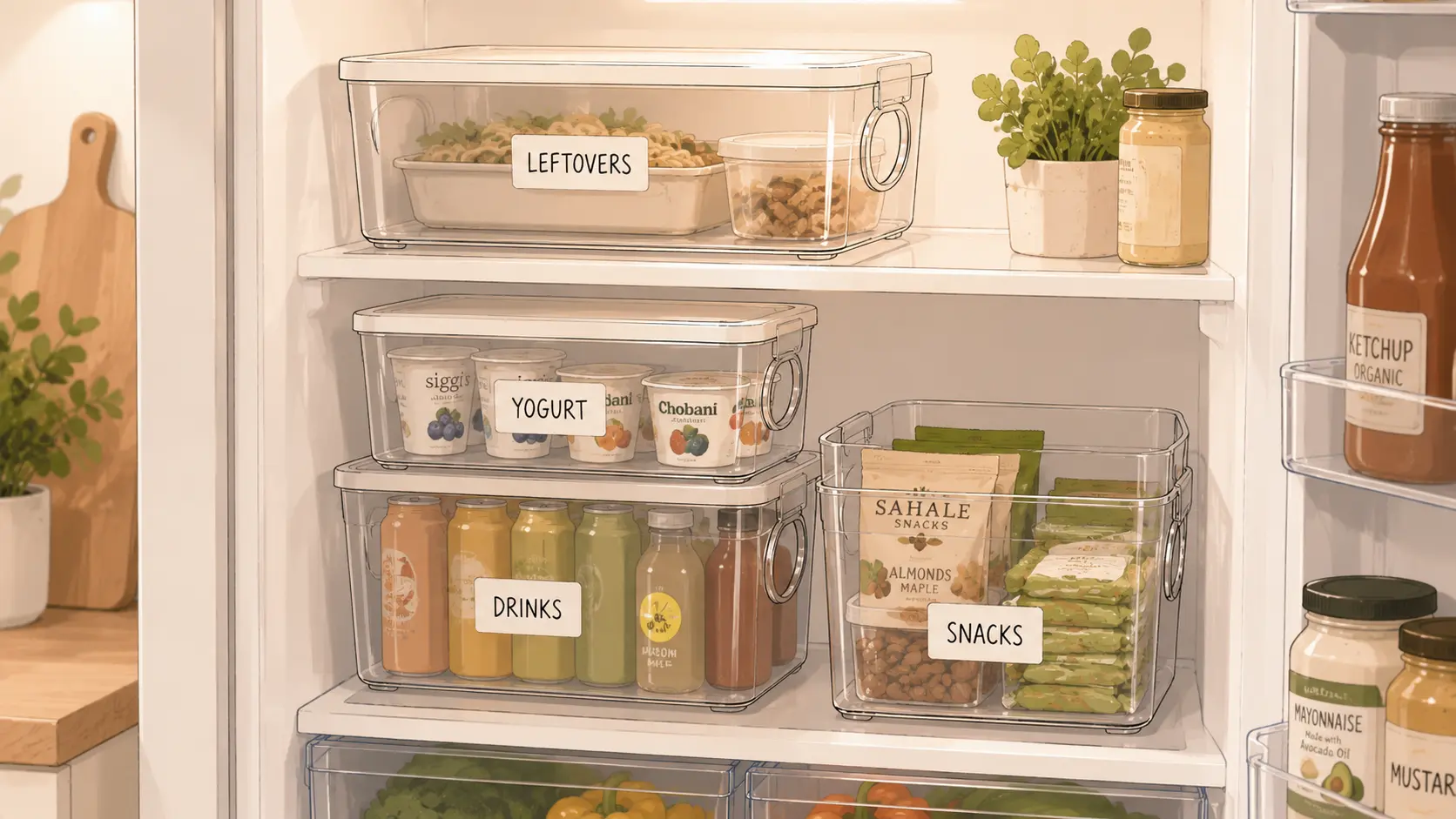
1. Clear Storage Bins with Handles
Best for: Grouping similar items on fridge shelves — dairy, drinks, snacks, leftovers, condiments.
Why you’ll love this:
- You stop buying food you already have. When every category lives in its own labeled bin, you see in one glance exactly what’s there — and what’s running low — before you ever open the Notes app for a grocery list.
- The handles are the feature that makes this actually usable. Pull out the entire “Leftovers” bin instead of excavating the whole shelf. Everything in the back becomes as accessible as everything in the front.
- Stackable bins let you build up instead of out, reclaiming the vertical space that most fridges waste. You’re not just tidying, but also adding effective storage capacity.
- BPA-free, food-safe plastic means these are safe to be in contact with your food — and most wipe clean with a damp cloth, so maintaining them doesn’t add to your list.
Tip: Measure your fridge shelf depth before ordering so bins don’t overhang the edge and block the door from closing cleanly.
2. Stackable Airtight Containers with Removable Colander
Best for: Storing leftovers, prepped food, washed produce, berries, cut fruit, and meal-prepped ingredients
Why you’ll love this:
- The airtight seal is what keeps your leftovers from becoming fridge archaeology. Food sealed properly lasts significantly longer than food in mismatched containers with loose lids, which means Monday’s chicken actually gets eaten on Wednesday instead of discovered on Friday.
- The built-in colander/strainer separates moisture from produce, so your berries and washed greens don’t sit in their own condensation and turn slimy within two days. You wash, drain, store, and grab — no extra steps.
- Stackable design recovers the shelf space that mismatched Tupperware destroys. Uniform rectangular containers stack cleanly and use every inch of vertical fridge space instead of sliding around and falling over.
- Clear walls mean you see exactly what’s inside at a glance — no more picking up three containers to find the one you want, no more mystery leftovers, no more forgetting that someone already prepped the chicken.
- Multiple sizes in one set handles everything from a portion of rice to a large batch of soup, so you stop using a giant container for a small amount of food (which accelerates spoilage by leaving too much airspace).
Tip: Choose rectangular over round — they fit flush against each other and the fridge wall, wasting almost no space, and stack more stably than rounded containers.
3. Dry-Erase Reusable Labels for Containers
Best for: Marking containers with contents and dates; labeling bins by zone
Why you’ll love this:
- They end the guessing game of “is this still good?” Write the contents and date directly on the container — so you know at a glance that the leftover soup was made Tuesday, not two weeks ago, and you eat it instead of throwing it out.
- Dishwasher-safe and 100% waterproof means these survive real kitchen use — through fridge, freezer, and wash cycles — without peeling off and floating around in your dishwasher or leaving sticky residue when you try to remove them.
- Write, erase, and reuse indefinitely. One pack of labels does the job permanently — you’re not buying new labels every time you meal prep or rotate your containers.
Tip: Apply labels to a clean, completely dry surface for the strongest hold. Labels applied to damp or greasy containers are the ones that eventually peel.
4. Activated Charcoal Deodorizer
Best for: Eliminating odors passively, on any shelf or in the door, without touching or treating food
Why you’ll love this:
- It eliminates odors at a molecular level rather than masking them with fragrance. That means you don’t swap out the smell of old leftovers for the smell of fake citrus. The fridge genuinely smells like nothing, which is exactly what it should smell like.
- Completely fragrance-free and non-toxic, so it’s safe around food and safe for families. Unlike scented alternatives that can subtly transfer artificial fragrance to uncovered food items.
- Lasts up to 6 months, which six times longer than a box of baking soda — so you set it down and forget about it, rather than replacing it every few weeks while never being sure if it’s still working.
Tip: Place it toward the middle or back of the fridge rather than the door for more consistent odor contact throughout the whole interior.
5. Produce Freshness Bags (Ethylene Absorber Technology)
Best for: Fruits, vegetables, berries, herbs — anything fresh that currently goes bad before you get to it.
Why you’ll love this:
- They work on the science of why produce actually spoils. Fruits and vegetables emit ethylene gas as they ripen — and that gas is what causes everything around them to ripen and deteriorate faster. These bags are made with natural ingredients that absorb and neutralize ethylene, slowing the entire process down.
- Produce kept inside stays fresh for up to 30 days, compared to a few days in standard bags or loose on a shelf. This means you can buy produce in bulk, use it across two weeks instead of one, and stop throwing away the second half of everything you buy.
- Each bag is reusable 8–10 times — rinse, dry, and reuse, so you’re not adding to single-use plastic waste or buying replacement bags constantly.
- Independently lab-tested and made in the USA from BPA-free materials, so you know the science isn’t just marketing — the efficacy is verified.
Tip: Make sure produce is dry before sealing it in the bag. Any surface moisture accelerates the spoilage process that these bags are designed to prevent.
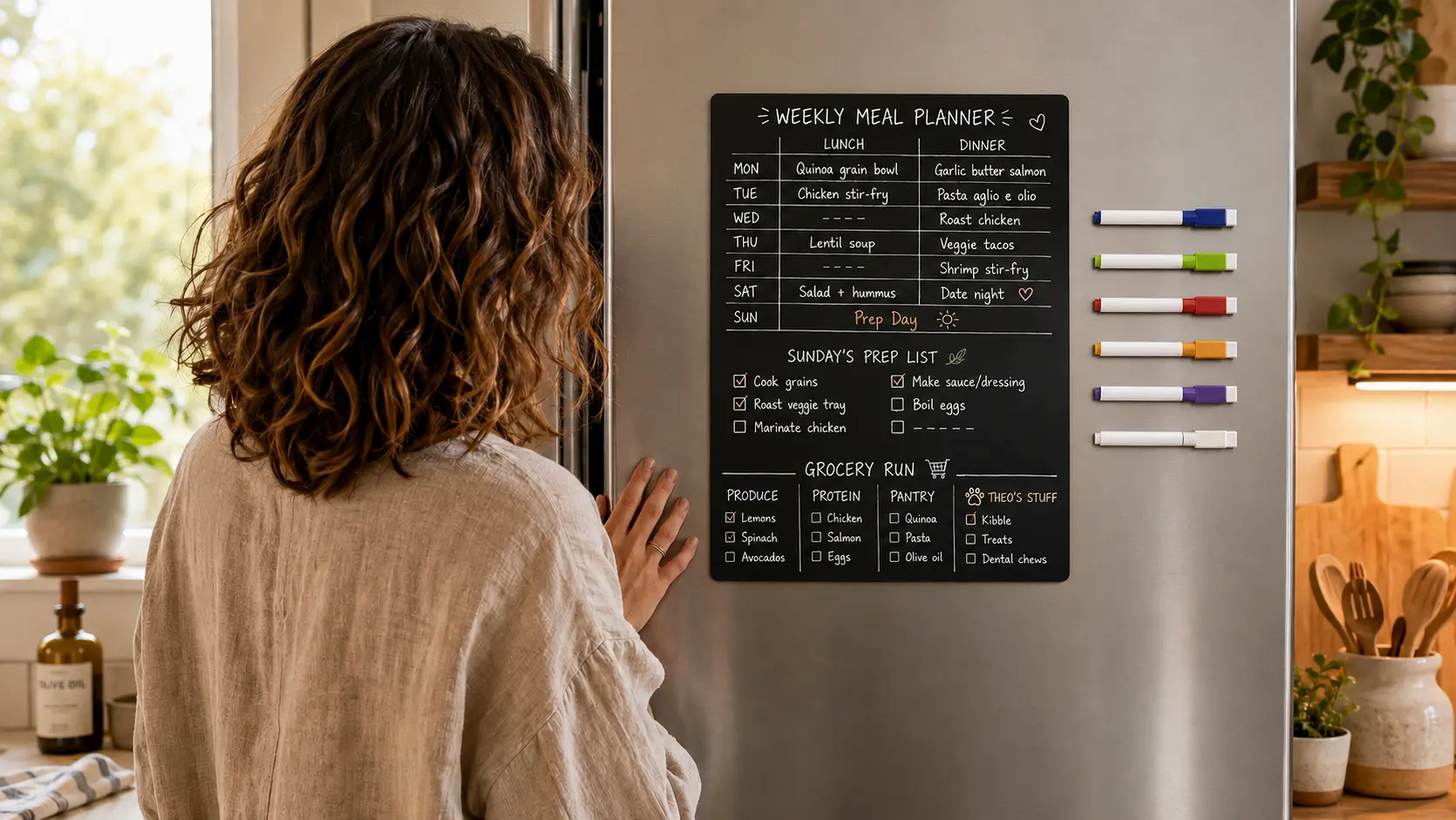
6. Magnetic Dry-Erase Board for the Fridge Door
Best for: Tracking what’s in the fridge, building a grocery list, planning meals for the week
Why you’ll love this:
- It closes the loop that every other organizing tool leaves open. Bins tell you where things are. Labels tell you what they are. The board on the door tells you what needs to be used this week, what’s running out, and what you’re actually cooking — so you stop buying duplicates and stop rediscovering food after it’s expired.
- Stain-resistant surface cleanly erases even after 30+ days without residue, which matters because a board that gets harder to read over time is one you’ll stop using within two weeks.
- Strong magnetic backing stays on the fridge without sliding or falling, and all markers and the eraser are magnetic too, so they live on the board and never get lost in a drawer.
- It becomes the command center for your kitchen — grocery list on one side, meals for the week on the other — so every person in the household is working from the same information without any apps, syncing, or remembering to check a shared document.
Tip: Before ordering, test a regular magnet on your fridge door — some stainless steel fridges are non-magnetic on the front and the board won’t adhere.
How to Set Up Your Fridge Organizing System in One Afternoon
Here’s how to put theses to work in a way that actually holds.
Step 1 — The Clean-Out (Do This Before Any Products Arrive)
Take everything out. Check expiration dates honestly and throw out what’s gone. Wipe every shelf and drawer with white vinegar and water or a non-toxic kitchen cleaner. This is the only moment the fridge will be completely empty and easy to clean.
Before you put anything back, write down what you have on your new magnetic board. This becomes your starting inventory — and it will reveal exactly how much space you actually have, which is almost always more than it felt like when everything was crammed in.
Step 2 — Map Your Zones Before Placing Anything Back
Use the temperature zone framework before you reach for any bin:
- Door: Condiments, jams, juices
- Bottom shelf: Raw meat and fish in a dedicated bin, sealed
- Middle shelves: Dairy, eggs, drinks, leftovers in labeled clear bins
- Crisper drawers: Fresh produce in freshness bags
Step 3 — Label Everything, Including the Bins Themselves
Label each bin with its zone (Dairy / Leftovers / Drinks / Snacks / Kids) using dry-erase labels on the front face. Label every container with contents and date. Set the magnetic board on the door. Place the deodorizer on a middle shelf and forget about it for the next six months.
This step takes about 20 minutes and is the difference between a fridge that looks organized only for a week and having a system that runs on its own.
Maintaining It — The 10-Minute Sunday Reset
The system doesn’t need a full reorganization every week. It needs a 10-minute reset:
- Move anything expiring soon to the front of its bin (FIFO)
- Update the magnetic board with what needs to be used this week
- Add anything running low to the grocery list while you’re already standing there
That’s it. Ten minutes on Sunday, and the whole week runs better.
Quick Tips That Make Your Organized Fridge Work Even Smarter
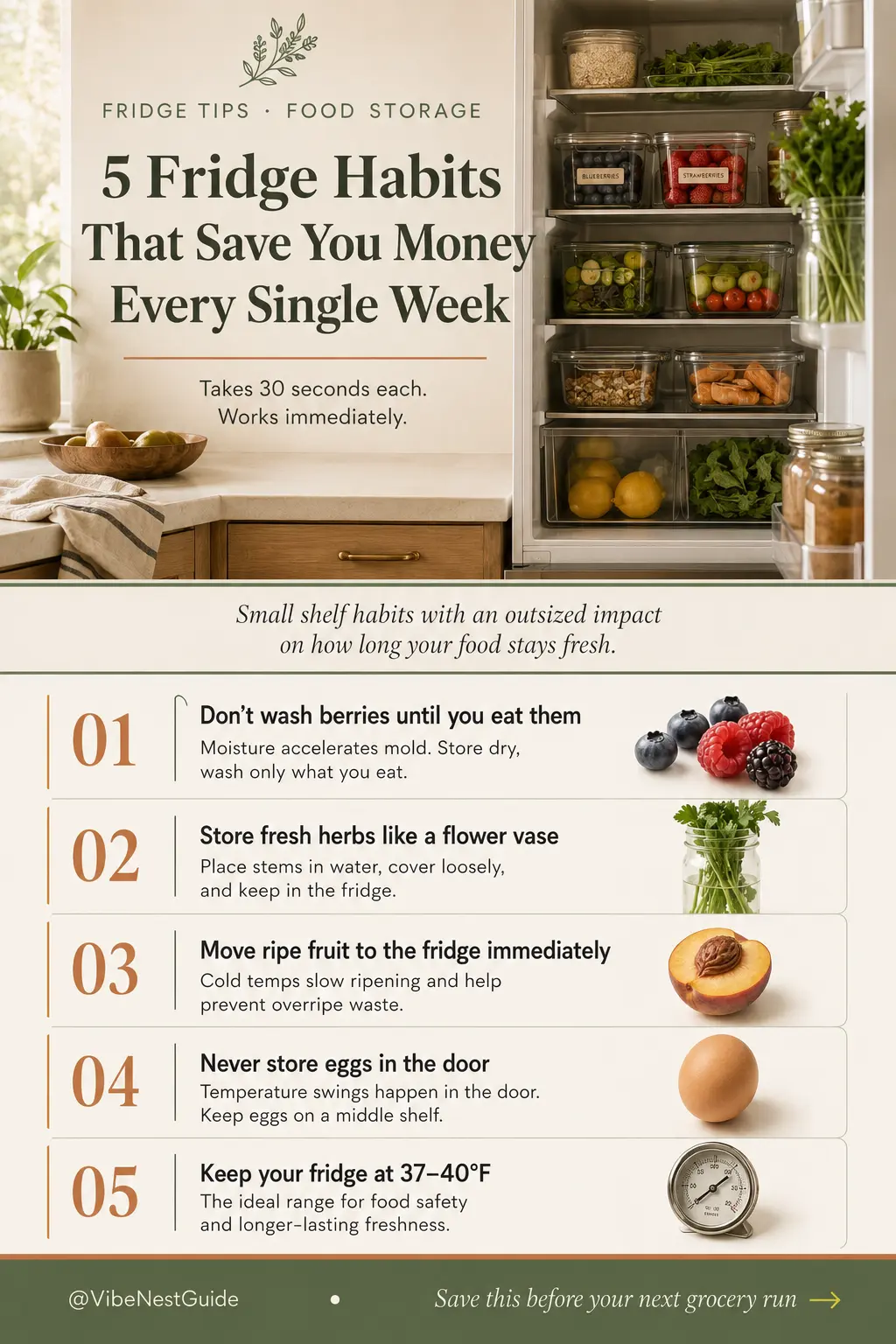
These take 30 seconds to apply and have an outsized impact on how long your food stays fresh.
Don’t wash berries until you’re ready to eat them. Moisture is what accelerates mold. Store them dry in a vented produce container and wash only what you’re about to eat.
Store fresh herbs like a vase of flowers. Trim the stems and keep them upright in a small jar of water on a middle shelf. They last 1–2 weeks this way compared to 3–4 days stuffed in a bag.
Move ripe fruit to the fridge immediately. Once something like a peach, avocado, or banana is ripe, transferring it to the fridge stops the ripening process and can add a few days to its life.
Never store eggs in the door. Temperature fluctuates every time the door opens. Eggs last significantly longer on a consistent middle shelf than in the door compartment designed for them.
Keep the fridge at 37–40°F. A basic fridge thermometer (under $6) tells you if your fridge is running warmer than it should — a common issue that silently shortens the life of everything inside.
Here’s the thing about a system: you don’t have to build it all at once.
If your biggest frustration is leftovers going bad because you forget what’s in them, start with the airtight containers and the labels. If it’s produce that’s already looking sad by Thursday, start with the freshness bags.
Pick the one product that solves your most frequent frustration, put it to work, and let the result show you which gap to close next. The goal isn’t a Pinterest-perfect fridge — it’s a kitchen that runs with less effort, less waste, and more money on the pocket in the form of groceries that always gets eaten.
- All Posts
- Aesthetic Lovers
- Home Chefs
- Intentional Parents
- Pet Lovers
- Productivity Seekers
- Smart Finds