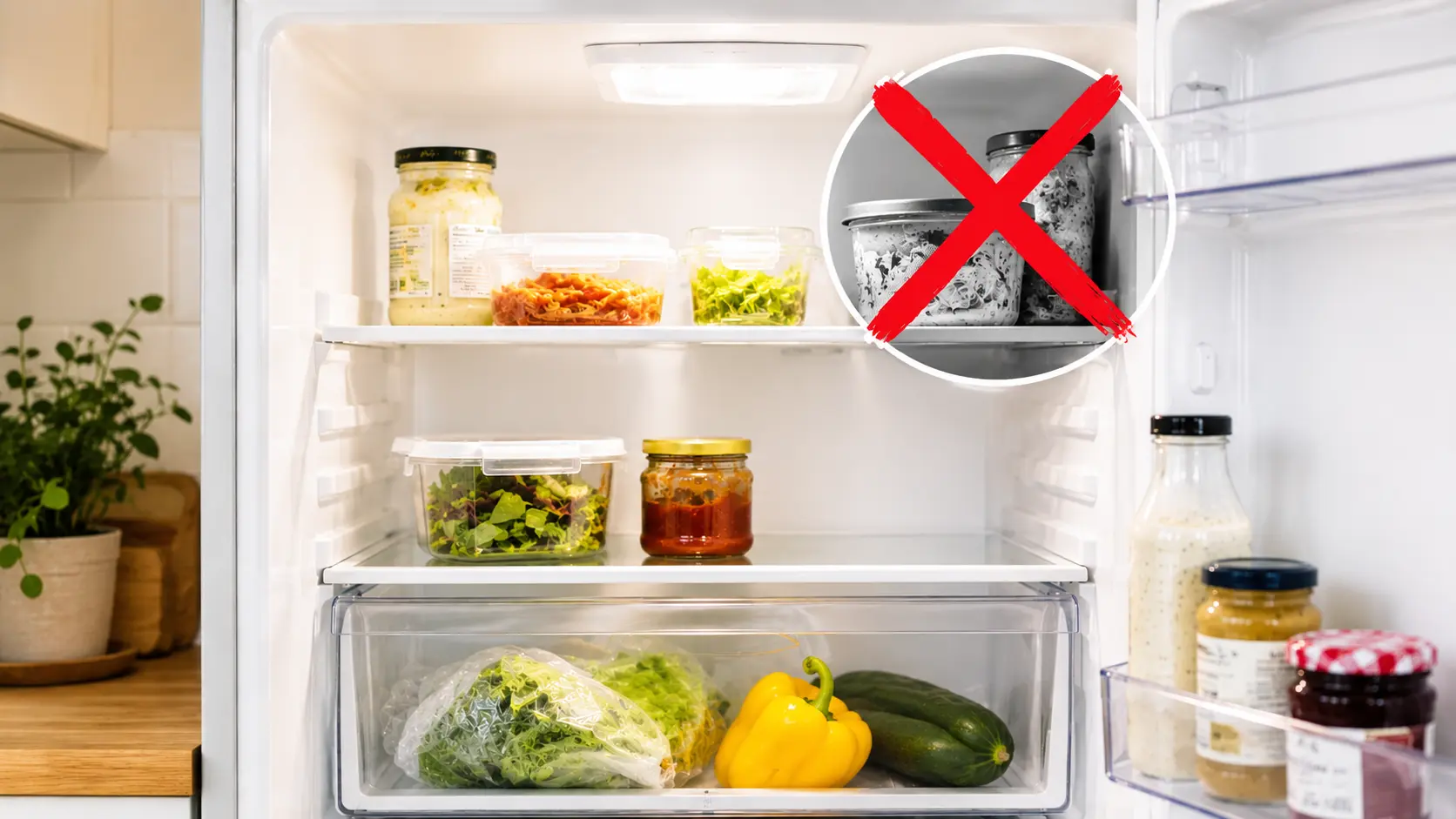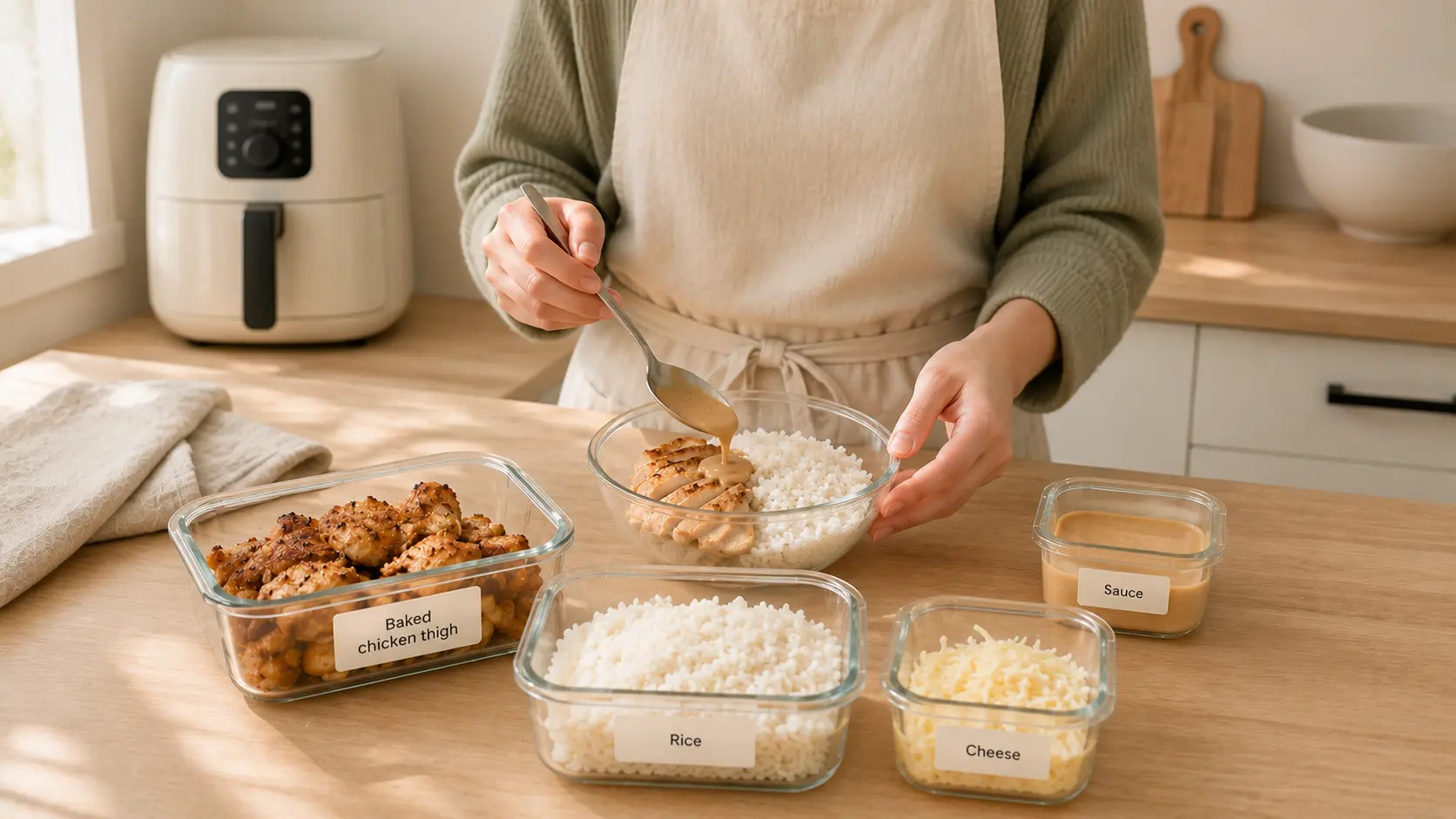
There’s a version of Sunday that feels calm and strategic instead of chaotic — two focused hours in the kitchen, containers neatly stacked in the fridge, breakfasts handled, lunches prepped, dinners halfway done before Monday even begins.
By Wednesday, you’re not staring at raw ingredients at 6:30 PM hoping inspiration strikes. You’re assembling. Reheating. Finishing.
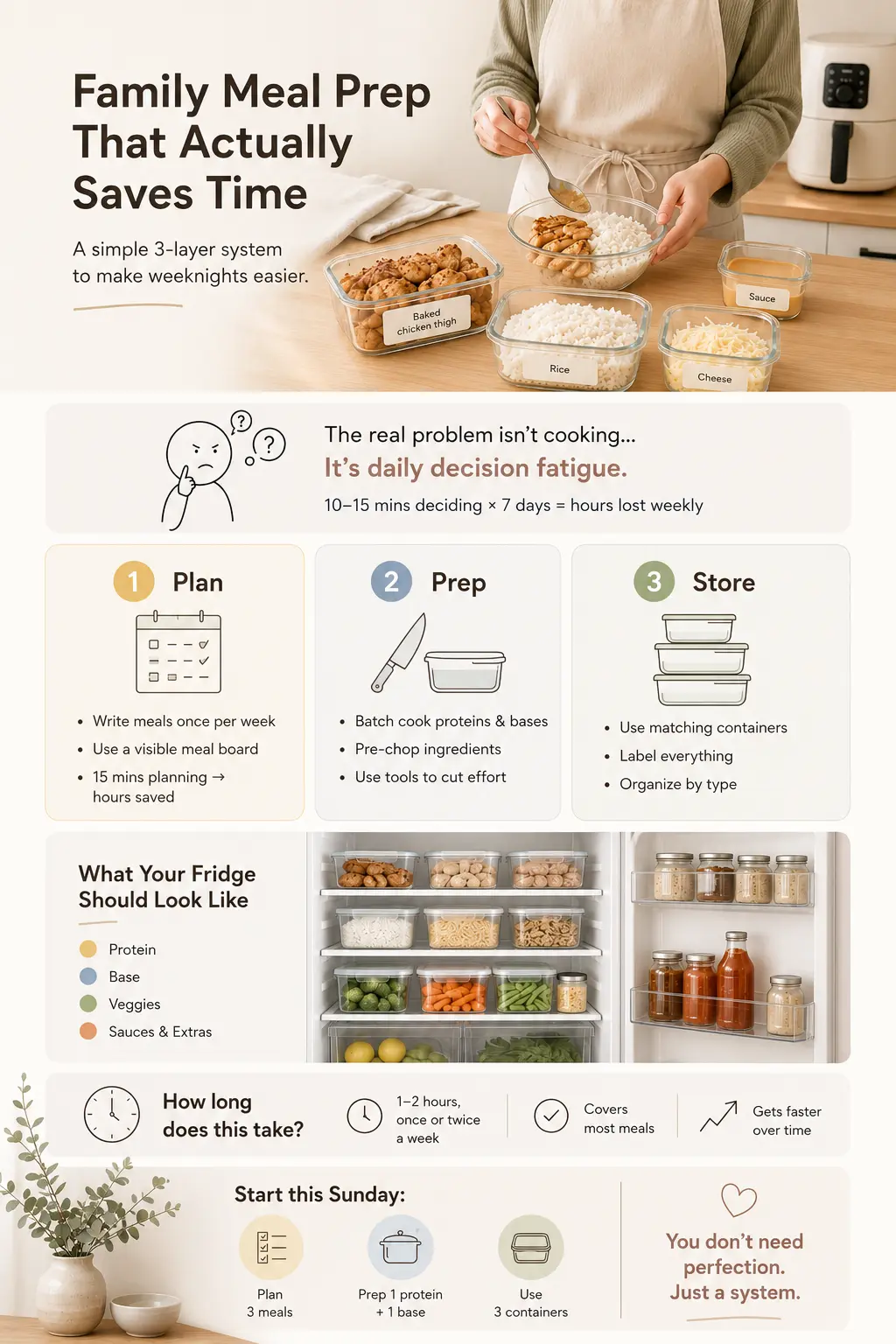
Research consistently shows families adopt meal prep primarily to reclaim time, and not to chase perfection. When meals are decided ahead of time, decision fatigue drops dramatically. Studies on food behavior suggest that the average person makes hundreds of food-related decisions daily — this is “food noise” of 1 to 2 hours – most of which disappear when meals are planned and portioned in advance. For families, that mental relief is as valuable as the food itself.
And this guide focuses on the practical tools that make family meal prep efficient and repeatable.
The Planning Layer: Weekly Meal Planning for Busy Parents
Most parents assume cooking takes the longest.
It doesn’t.
The real time drain is indecision — that daily 10–15 minutes spent asking:
- What are we making tonight?
- Do we have the ingredients?
- Will the kids eat it?
- When will I have time to cook it?
Multiply that by seven days and you’ve lost nearly two hours before even touching a plate.
Build a Visible Weekly Meal Plan to Reduce Decision Fatigue
A weekly meal planning whiteboard or magnetic planner board mounted in the kitchen removes guesswork entirely. The entire week’s meals are visible at once. Everyone in the household can see it.
That visibility matters.
It reduces repeated “What’s for dinner?” questions and replaces daily decision-making with one intentional 15-minute planning session on Sunday. This time savings will compound quickly.
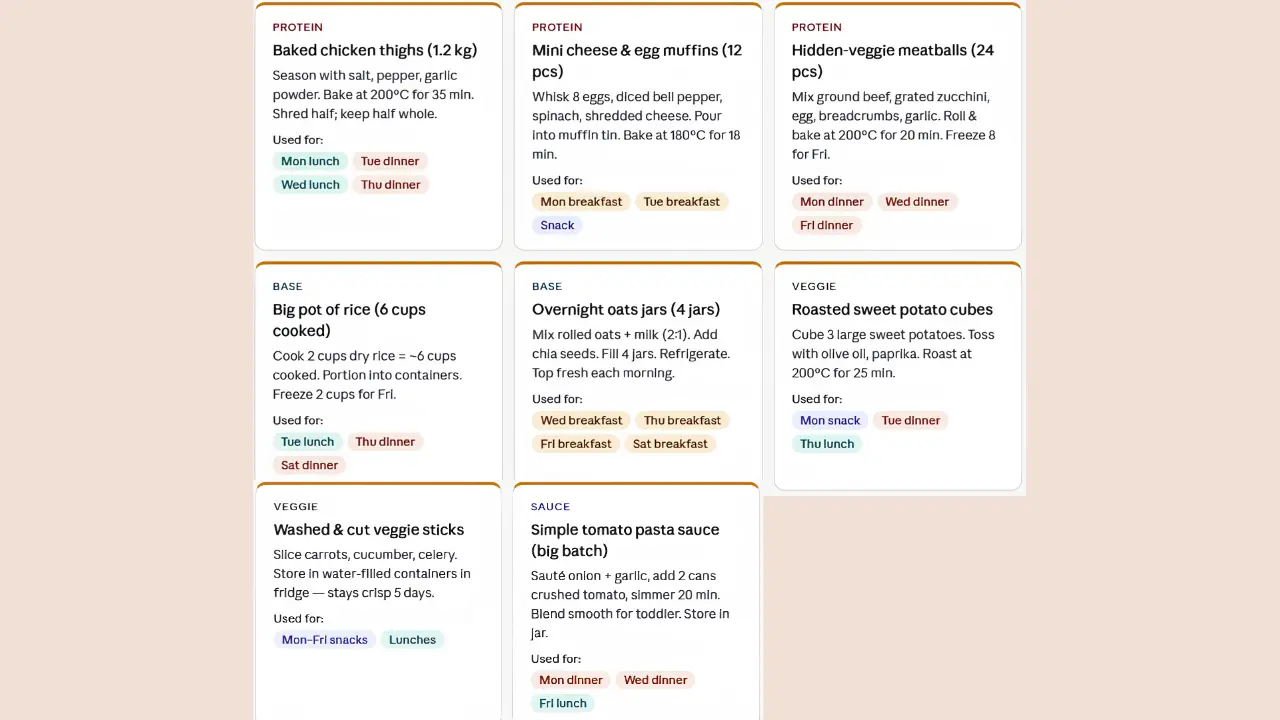
Sample Meal Prep Batching
Track What Actually Works for Picky Eaters
Alongside the board, a meal prep notebook or planning journal becomes your long-term strategy tool.
Use it to record:
- Meals your family consistently eats
- Recipes that take under 30 minutes
- Go-to emergency dinners
- What didn’t work
Over time, this builds a reliable rotation. Instead of reinventing the wheel every week, you refine what already works.
Optimize Your Meal Prep Grocery List and Shopping Efficiency
Planning also improves grocery efficiency. When your shopping list is built directly from the board, food waste drops, grocery trip and takeout spending decreases. The savings begin before cooking starts.
The Prep Layer: Batch Cooking for Families to Cut Hands-On Time
Once the plan is set, prep day becomes execution. This is where physical tools dramatically change the experience.
The goal: to reduce active effort — the chopping, slicing, grating, and portioning that determines whether Sunday prep feels empowering or exhausting.
The Biggest Time Saver for Family Meal Prep Beginners
A food processor with multiple blade attachments eliminates repetitive knife work.
Instead of:
- Grating cheese by hand for 5 minutes
- Slicing vegetables one by one
- Processing sauces in batches
You finish, well, not in seconds… but at least twice as fast as you’re doing before.
And for families prepping multiple meals at once, the cumulative time saved across a two-hour session can easily reach 45 to 60 minutes!
Precision and Safety During Your Meal Prep Sunday
Not everything belongs in a processor. A quality chef’s knife paired with a large cutting board handles proteins, herbs, and detailed cuts more efficiently than bulky appliances.
A sharp knife is faster and safer than a dull one, and maintaining it properly reduces fatigue and speeds up prep dramatically.
The Storage Layer: Food Storage Containers and Fridge Organization
Meal prep doesn’t break down during cooking. It breaks down in the fridge.
If storage is chaotic — mismatched lids, unclear portions, hidden containers — the system collapses midweek. Food goes unseen. Meals get forgotten. Takeout sneaks back in.
Standardize Your Containers
A coordinated set of stackable glass meal prep containers (multi-size set) creates immediate visual order.
Glass offers several advantages:
- No odor retention
- Oven- and microwave-safe
- Durable long-term
- Non-reactive when reheating
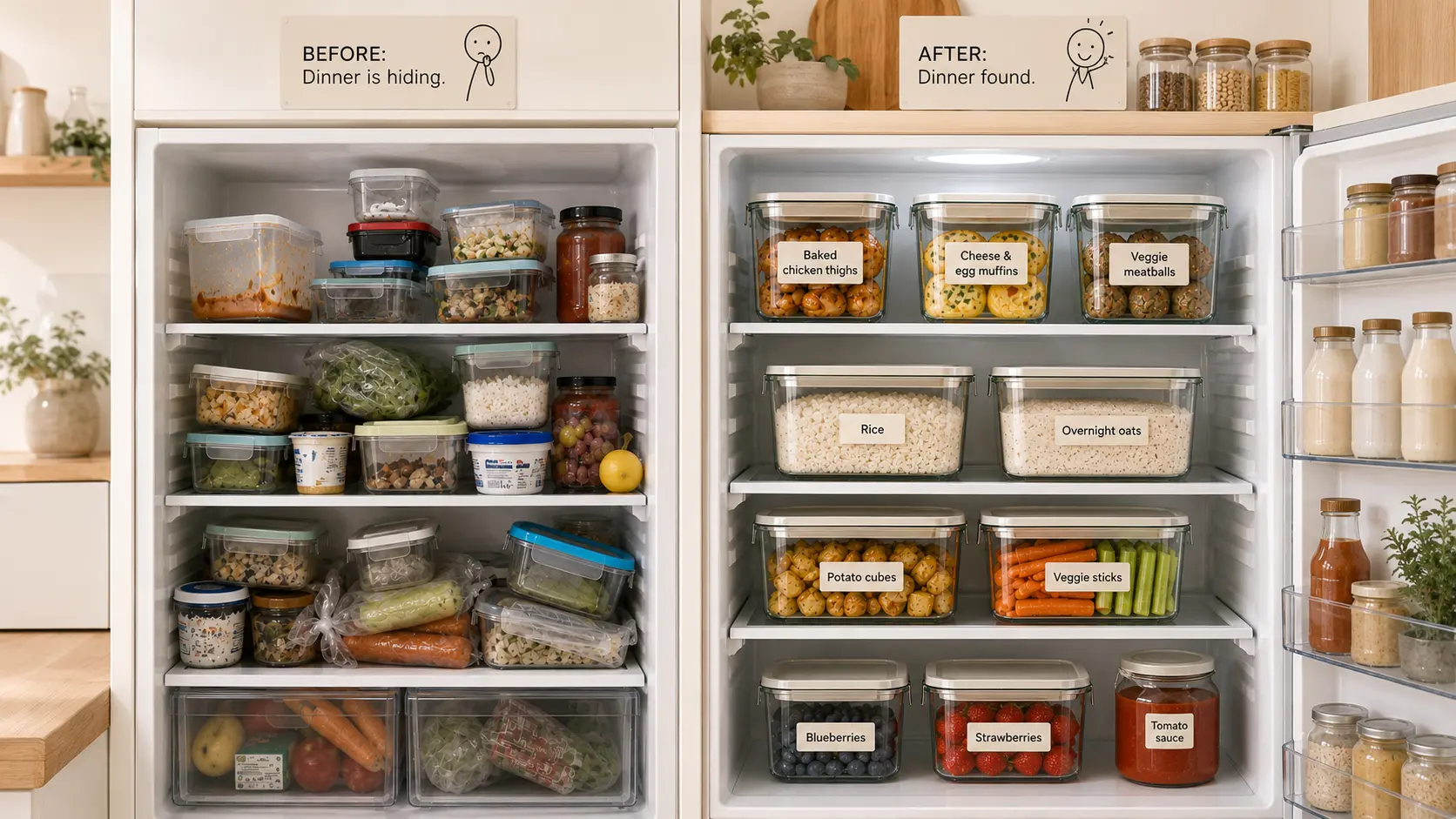
Uniform sizing allows vertical stacking, maximizing fridge space and making meals visible at a glance.
When you can easily see what you’ve prepped, you use it.
Freezer Meal Ideas to Extend Your Healthy Family Meals
Freezer strategy separates occasional meal prep from sustainable meal prep.
A set of freezer-safe silicone bags or reusable freezer containers allows soups, sauces, proteins, and breakfast items to be prepared in larger quantities and saved safely. Freezing doubles the lifespan of a single prep session.
Labeling and Designing the Fridge for Busy Families
Label everything clearly using a waterproof kitchen label maker. Date and contents eliminate the midweek uncertainty that leads to waste.
When organized properly, the fridge becomes a functional menu:
- Components at the back
- Grab-and-go lunches at eye level
- Snacks at child-reachable height
Children gain independence. Partners assemble meals without asking. Dinners become reheating and assembling rather than cooking from scratch.
The Speed Layer: Turning Batch Prep Into Weeknight Dinners
Even with thorough prep, weeknights still require finishing touches. But instead of starting from zero, you’re building from prepared components.
Fast, Healthy Meals With an Air Fryer
An air fryer bridges the gap between fridge and table. Unlike microwaves, it reheats proteins and vegetables without making them soggy. Unlike ovens, it requires no long preheat time.
Prepped chicken thighs: ready in minutes.
Frozen batch-cooked meatballs: hot and crisp quickly.
It transforms reheating into a quality finish rather than a compromise.
One-Pot Family Dinners and Simple Clean-Up
For families who rely on soups, sauces, smoothies, and purées, a handheld immersion blender simplifies everything.
Instead of transferring hot liquids to a countertop blender in batches, blend directly in the pot in under two minutes.
Less mess. Less cleanup. Less friction.
Soups — one of the most efficient family meals — become even easier to maintain weekly.
The Bigger Picture
These four layers — planning, prep, storage, and speed — work together as a system. The tools themselves aren’t the goal.
The goal is:
- Fewer rushed evenings
- Less decision fatigue
- More consistent nourishment
- More presence at the dinner table
When the environment supports the habit, consistency becomes automatic.
You’re not just prepping food. You’re protecting your time, your energy, and your family’s connection.
Frequently Asked Questions (FAQs):
1. How long does meal prepped food actually last in the fridge?
Most cooked proteins, grains, and roasted vegetables stay fresh for 3 to 4 days when stored in airtight containers in the fridge. Soups, stews, and casseroles can stretch to 5 days. For anything beyond that, the freezer is your best friend — most prepped meals freeze well for up to 3 months.
2. How do I meal prep when my kids have completely different tastes?
The trick is to prep components separately rather than fully assembled meals. Cook a big batch of a base protein, grain, and vegetable, then let each family member build their own plate — think taco bowls, rice bowls, or pasta nights where everyone customizes their toppings. This way you’re cooking once but satisfying multiple preferences without making separate meals.
3. How long does family meal prep actually take each week?
For most families, a focused prep session of 1 to 2 hours once or twice a week is enough to cover the bulk of dinners and lunches. The key is not trying to cook everything from scratch — pre-chop vegetables, pre-cook grains and proteins, and rely on a few batch-cook staples rather than fully plated meals. The more consistent your routine, the faster each session gets.
- All Posts
- Aesthetic Lovers
- Home Chefs
- Intentional Parents
- Pet Lovers
- Productivity Seekers
- Smart Finds